Building stronger local communities through skill exchange
A self-initiated UX concept exploring how people can exchange skills instead of money. Inspired by seeing talented friends struggle to find the right people despite having complementary skills, the project explores how thoughtful product design can make local collaboration easier, safer, and more accessible.
This concept also explores an AI-assisted design workflow. Research and early ideation were completed in four days, with AI used to rapidly explore concepts before refining the product through UX thinking and iteration in Figma. The UI shown represents the current concept direction and will continue to evolve.
Create a trusted marketplace for exchanging services instead of money
- Help people discover hidden talent within their local community
- Reduce financial barriers to learning new skills
- Increase meaningful local connections
- Encourage collaboration over competition
A bit of backstory...
Over the last few years, I've noticed something interesting: almost everyone around me has a valuable skill they're incredibly good at. Yet despite all this talent, we still default to paying strangers for services that could often be exchanged within our own communities.
That became especially clear when my photographer friend wanted a tattoo, while my tattoo artist friend needed professional photos for her portfolio. I introduced them, they traded their services, and both got exactly what they needed without spending any money.
That made me wonder: How many opportunities like this never happen simply because people don't know each other exist?
Why it matters
The freelance and creator economy is growing rapidly, yet access to services still depends largely on money. Millions of people have valuable skills but limited disposable income, while others are looking to build portfolios, gain experience, or simply help others.
Recent trends show:
- More than 1 in 4 U.S. knowledge workers now freelance or work independently.
- Nearly 43% of Gen Z workers participate in the gig economy.
- The U.S. is projected to have 86.5 million freelancers by 2027.
Yet existing platforms focus almost entirely on paid work.
If you can't afford to hire someone, or don't necessarily want to monetize your hobby, there are very few places designed around mutual exchange instead of transactions.
Valuable skills exist everywhere, but they're invisible.
People don't struggle because they lack talent, they struggle because there isn't an easy way to discover who can help them, build trust with strangers, and find an exchange that feels fair.
Today's options all have tradeoffs:
• Hire someone (expensive)
• Ask friends (limited network)
• Facebook groups (unstructured)
• Freelance platforms (transactional)
None are designed around community-driven skill exchange.
The real challenge isn't finding people. it's finding the right exchange.
A marketplace where everyone has something valuable to offer.
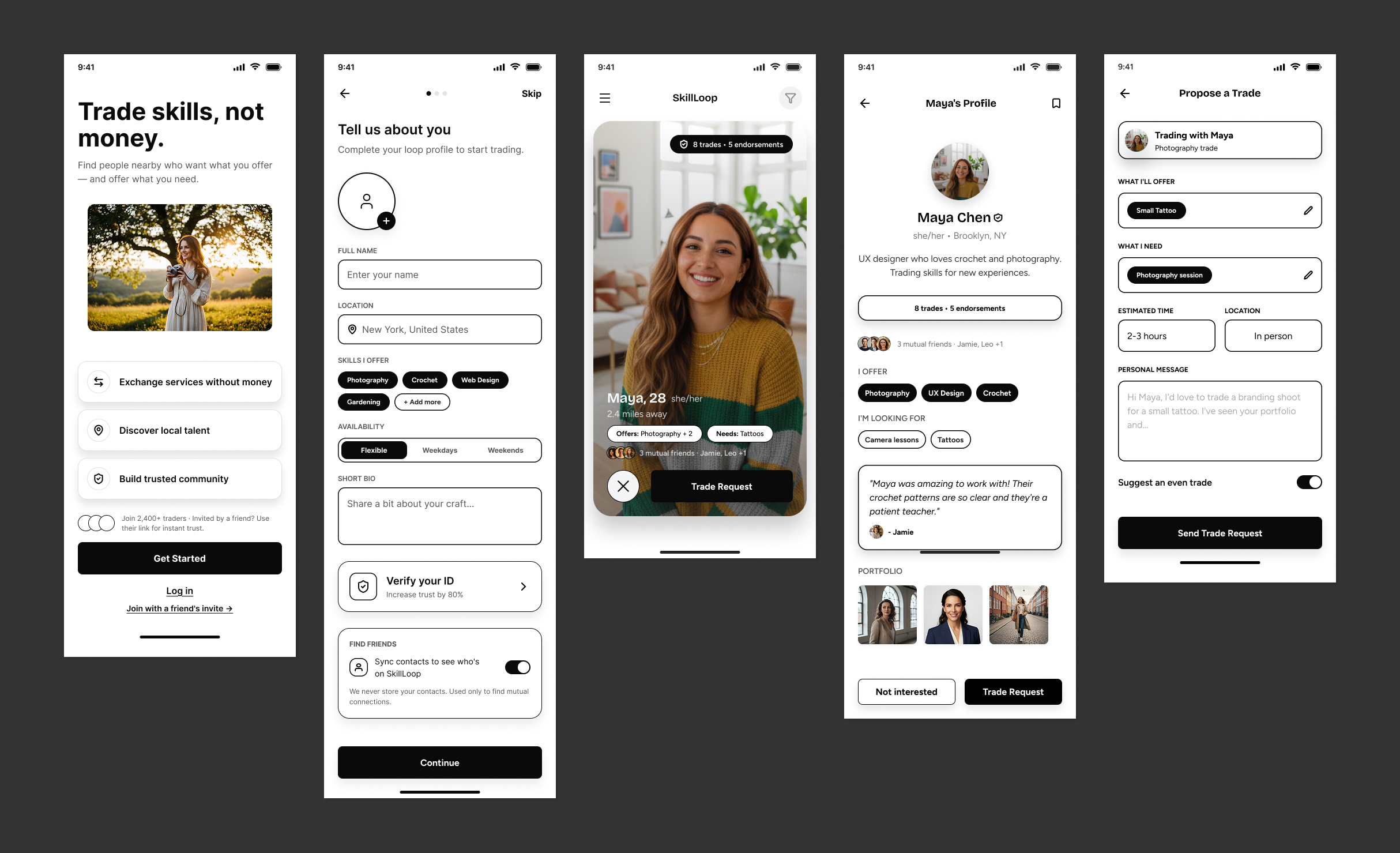
The final concept combines the familiarity of modern matching apps with trust features inspired by professional marketplaces, making it easy to discover people who have the skills you need while offering your own in return.
Users create a verified profile, browse nearby people based on complementary skills, and explore portfolios, endorsements, and mutual connections before proposing a trade. By designing around trust, discovery, and community, the experience transforms networking into a simple, collaborative way to exchange value without relying on money.
Understanding why people don't exchange skills today
Research into collaborative consumption, the sharing economy, and freelancing revealed three recurring barriers to peer-to-peer service exchange.
Literature Review
Existing research consistently shows that successful peer-to-peer platforms rely on trust, identity verification, and reputation systems to encourage participation. Community-based exchanges are most successful when users feel:
- Safe
- Valued
- Confident that exchanges are fair
User Interviews
I conducted five 30-minute, in-person interviews with participants aged 22–38 living in the New York City/Brooklyn area.
Everyone has something valuable
Participants consistently dismissed their own abilities as "not good enough."
Meanwhile others saw those same skills as highly valuable.
Discovery is the biggest barrier
The problem wasn't willingness.
It was visibility, people simply didn't know these opportunities existed.
Trust comes before exchange
Before agreeing to meet someone, users wanted some type of security:
Identity verification, Reviews, Shared connections
Structure that follows behavior
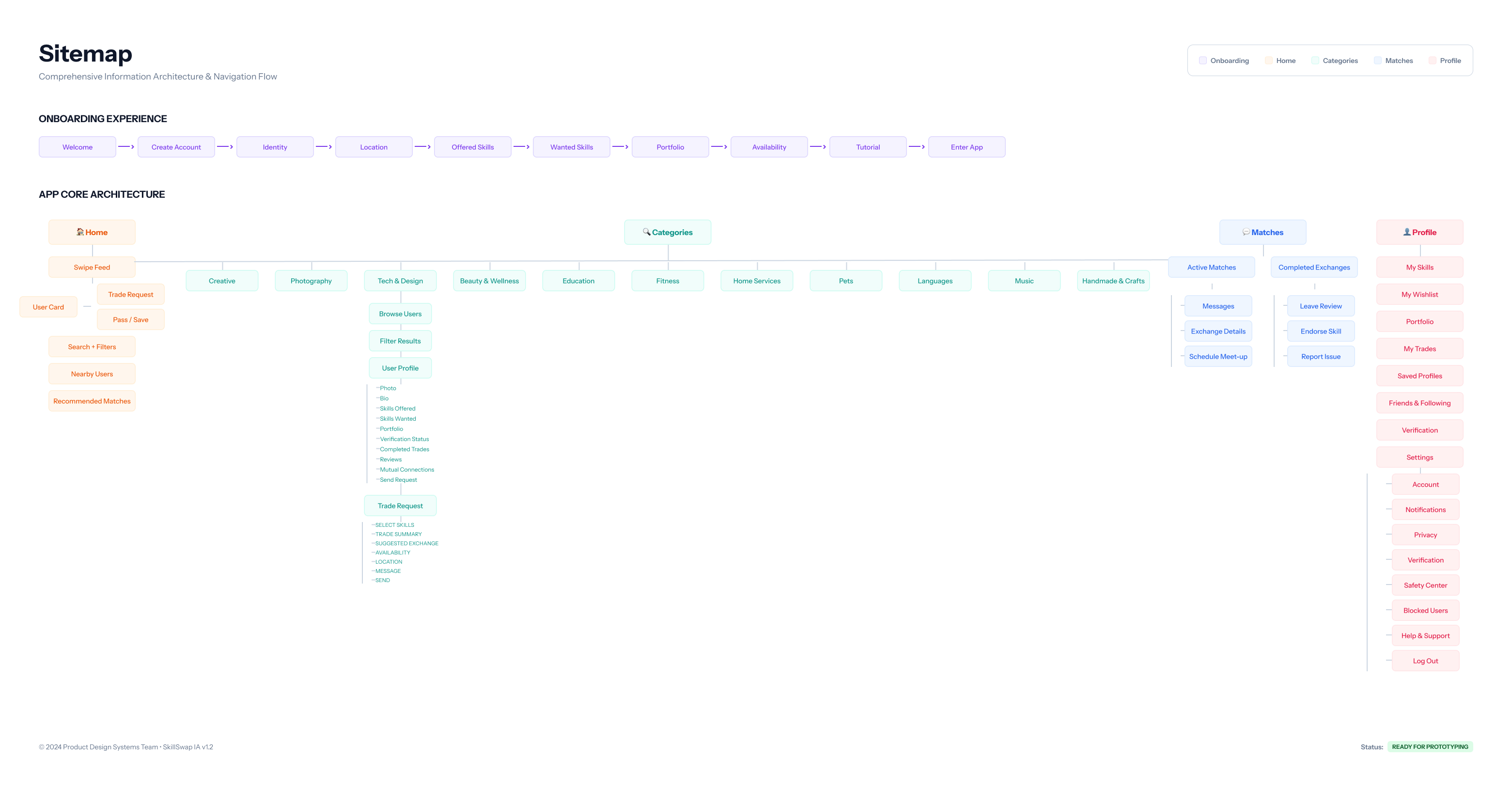
Once the concept was defined, I mapped the user journey around discovery, trust, and connection. The information architecture guides users naturally from exploring profiles to verification, trade requests, and conversation. The discovery flow was intentionally inspired by familiar app patterns, helping match users' existing mental models and reducing friction when exploring new connections.
Early Concept Exploration
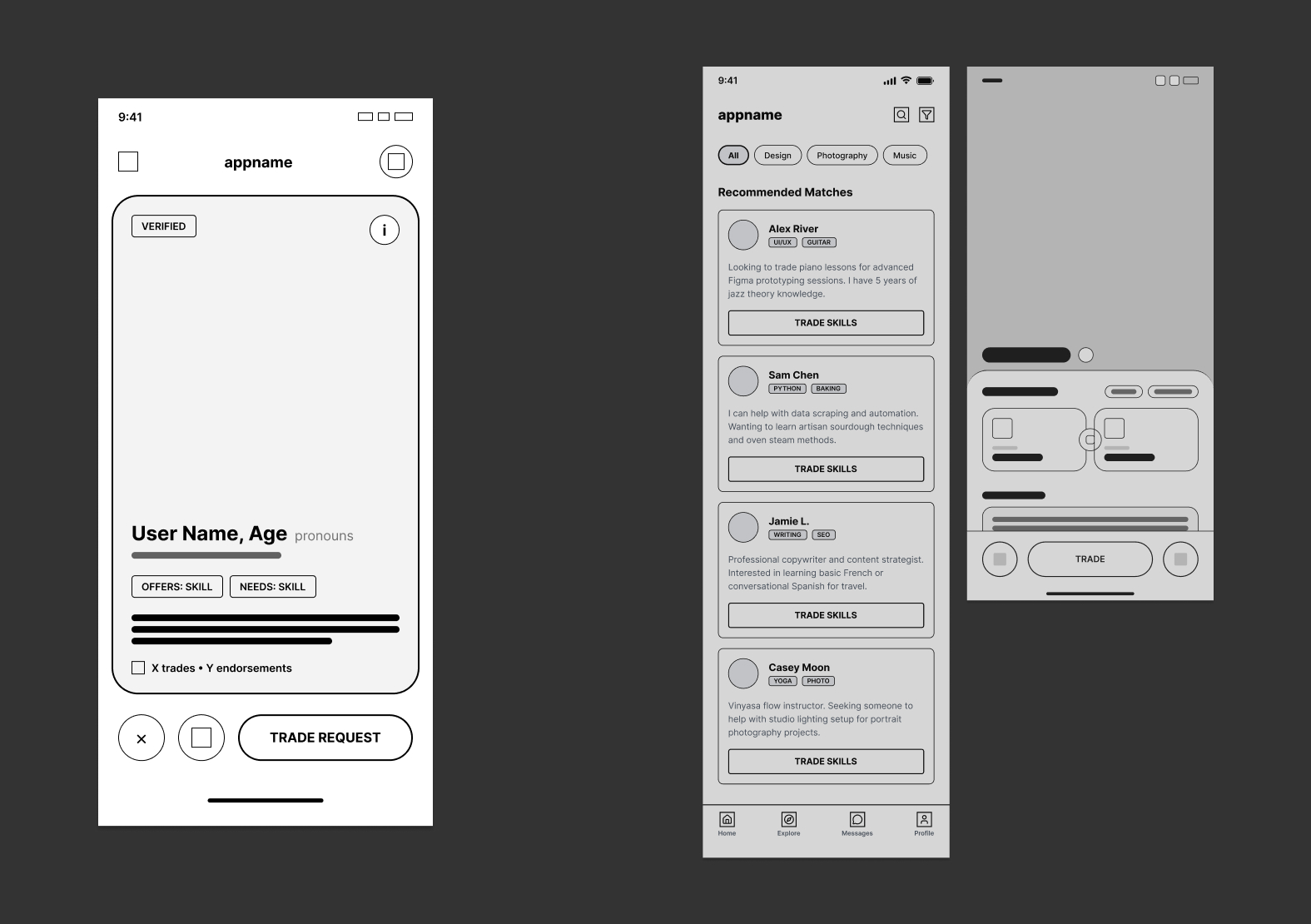
I used AI to rapidly explore multiple product directions and challenge early assumptions. I explored concepts including a traditional marketplace, a local map, a community board, a request-based platform, and a swipe-style matching experience.
The swipe interface proved to be the strongest direction, reducing cognitive load while making discovery feel faster, more engaging, and more personal.
Trust your friends not just verifying
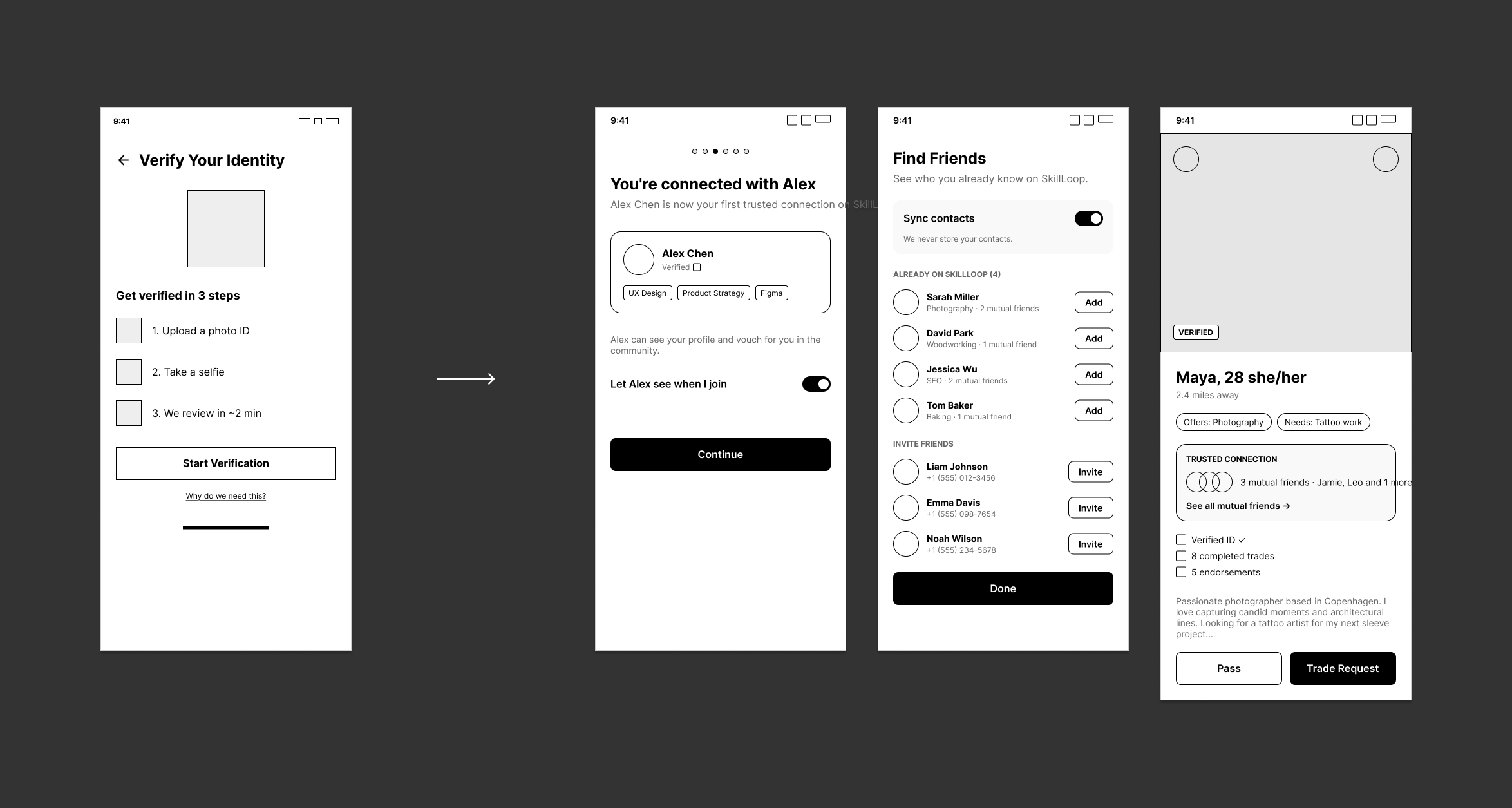
User testing revealed that trust was a bigger concern than the exchange itself. While identity verification increased confidence, participants wanted additional social proof before meeting someone new.
In response, I iterated the concept by introducing mutual connections and a lightweight social network. Users can follow one another, build trusted circles, and discover people through friends, reinforcing the original vision of connecting local communities through shared skills.
Turning local talent into meaningful connections.
The final concept combines the familiarity of modern matching apps with trust features inspired by professional marketplaces, making it easy to discover people who have the skills you need while offering your own in return.
Users create a verified profile, browse nearby people based on complementary skills, and explore portfolios, endorsements, and mutual connections before proposing a trade. By designing around trust, discovery, and community, the experience transforms networking into a simple, collaborative way to exchange value without relying on money.
From discovery to trade
Rather than simply matching with someone, the experience is designed to encourage fast conversations. Users can quickly evaluate trust through mutual connections and verified profiles before proposing a trade, making it easy to move from discovery to collaboration.
- Build trust first through verified identities, mutual friends, and endorsements before reaching out.
- Explore the full profile to review portfolios, completed trades, and the skills each person offers and is looking for.
- Start the conversation immediately by sending a personalized trade request instead of simply liking a profile.
Final reflection
This project reinforced how AI can accelerate the early stages of product design without replacing the design process itself. By using AI to rapidly explore concepts and interaction patterns, I was able to spend more time validating ideas, iterating on feedback, and refining the user experience in Figma.
The next step is to continue evolving the visual design into a polished, production-ready UI. While I've already made several manual refinements, the interface still needs to be built out across more scenarios, tested at scale, and further refined to ensure consistency and accessibility throughout the product.
What excites me most is this new way of designing. AI allows me to move through research and ideation much faster, quickly test multiple directions, and arrive at stronger product decisions. Rather than replacing UX thinking, it gives me more time to focus on what matters most: understanding users, iterating on feedback, and designing experiences that solve real problems.